
Hours at a desk can leave your back tight, your neck stiff, and your energy flat. A standing desk converter can help, but choosing one is not always simple. Here are five top options recommended after going through real user feedback and expert criteria:
Top Standing Desk Converter Picks
These options are selected based on build quality, ergonomics, and long term user satisfaction. They suit different budgets and work styles, so there should be at least one that fits your setup.

- Create Instant Active Standing - VIVO’s desk riser provides on-demand standing throughout the day for the freedom to get out of your chair and relieve muscle tension, reduce stress, and increase productivity. --Patented--

- Adjust to Get it Just Right: Ready to stand? Squeeze the handle and use your weight to adjust the height of your workstation. Our TechOrbits stand-up workstation is perfect for dynamic working styles and easily raises to your desired level (4.3” to 19.7”)

- Comfortable & Organized Workstation: With a design that maximizes legroom — this desk lets you sit and move comfortably without bumping your knees. The deeper desktop and two drawers offer plenty of storage for office supplies, helping you create a tidy and multitask-friendly environment.

- Create Instant Active Standing: VIVO’s desk riser provides on-demand standing throughout the day for the freedom to get out of your chair and relieve muscle tension, reduce stress, and increase productivity --Patented--
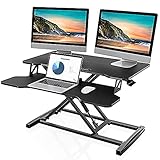
- 【Spacious Work Area】: The top surface measures 31.5” x 15.7” providing plenty of space for single monitor, dual monitor, and laptop + computer monitor setups. Raises up to 19.8 inches and lowers down to 4.3 inches making this ideal for you no matter your height.
Why a Standing Desk Converter Can Change Your Workday
A standing desk converter sits on top of your current desk and lets you switch between sitting and standing without replacing the whole desk. It is a practical way to test a standing routine without a full furniture upgrade.
Many people want to stand more, but they do not want to spend a large amount on a full height adjustable desk or deal with moving heavy furniture. A converter is a middle step. It lifts your screen, keyboard, and mouse to standing height, then drops back down when you want to sit.
The real benefit is not standing all day. It is being able to change positions often, without breaking your work focus.
The key is movement. Small posture changes across the day can reduce stiffness, help circulation, and even keep focus more stable. Standing desk converters make those shifts easier and quicker.
Types of Standing Desk Converters
Not all converters work the same way. Before anything else, it helps to understand the main types you will see.
1. Z-Lift / X-Lift Converters
These are the most common. The base stays on your desk, and the work surface rises up on a Z or X shaped metal frame.
They usually lift straight up and down or slightly toward you. Many have a separate keyboard tray below the main surface.
Z-lift converters usually offer the best mix of stability, price, and ease of setup for most users.
They suit people who want a simple, strong platform and do not need the whole desk surface to rise.
2. Post and Keyboard Tray Designs
These have a single pole or arm attached to a clamp on the back of your desk. A platform for your keyboard and sometimes a smaller monitor mount attaches to the pole.
They save desk space, but they can move more if you type hard. Cable management can also be a bit more involved with these setups.
3. Full Surface Lift Converters
These raise almost the entire top surface, acting like a mini sit stand desk on top of your old one. The whole top panel moves up together, including everything you place on it.
They are often deeper and heavier, but they feel closer to a real height adjustable desk. This style suits people with multiple monitors or many papers and accessories.
4. Electric Standing Desk Converters
Electric models use a motor to lift and lower the platform with a button or small control panel. They are slower to adjust than grabbing and lifting, but they need less effort and can handle more weight.
They help people with wrist, shoulder, or back issues who find manual lifting uncomfortable or risky.
Key Features That Make a Good Standing Desk Converter
There are many products on the market, and many look similar at first glance. The details matter, both for comfort and safety.
Height Range and User Height
The most common mistake is buying a converter that does not get tall enough. If you are tall, this matters even more.
For comfortable standing typing, your elbows should bend roughly to a right angle, with your forearms level to the floor. The top of your screen should be around eye level or slightly below.
When checking height specs, you want to look at two numbers:
- Maximum keyboard height above your original desk surface
- Maximum monitor surface or mount height above your original desk surface
A converter that looks compact on the product page can sometimes be too short for users over average height, even if the weight rating looks great.
If you are taller, aim for a converter that can bring the keyboard tray to at least around 16 to 18 inches above your existing desk. Shorter users can manage with a lower range. This is a rough guide, not a strict rule, but it helps avoid the most common sizing problems.
Work Surface Size and Layout
Next, you need enough room for how you actually work. Not a clean marketing photo version of your desk, but your real one.
Ask questions like:
- Do you use one monitor or two
- Do you need space for a laptop next to a screen
- Do you write on paper often
- Do you use an external keyboard and mouse
Measure your current monitor stand or base and compare it to the converter platform dimensions. If you plan to use dual monitors, check both the platform width and the stated max monitor width for any mounting arms included.
A cramped surface will push your mouse too far to the side, which can strain the shoulder over time. Extra width is not just comfort. It can be a health factor.
Keyboard Tray Design
The keyboard tray is where many converters differ. Some are flush with the main surface, some sit a little lower, and some are small and unstable.
A good keyboard tray should:
- Be wide enough for keyboard and mouse with some space to spare
- Stay level and not wobble when you type
- Allow your wrists to stay straight, not bent upward
If the tray is too high relative to your elbows, you may end up raising your shoulders and tensing your neck. If it is too low, you may hunch forward. That is why the distance between the monitor surface and the keyboard tray matters, not just the total height.
Weight Capacity and Stability
Weight ratings look good on spec sheets, but how the converter feels when it is fully loaded is more important. A slight shake might not bother a light typist, but a stronger typist will notice it all day.
Areas to check:
- Total weight limit for the upper surface and keyboard tray
- Whether the product mentions support for dual monitors
- Reviews that describe wobble at full height
If you use heavy monitors or a monitor arm plus speakers, choose a model where users clearly mention strong stability. Extra weight on a weak frame can create small but constant movement that strains eyes and hands.
Adjustment Mechanism and Ease of Use
The way a converter moves affects how often you will actually use it. If it feels hard to lift, you might end up leaving it in one position, which defeats the whole purpose.
Common mechanisms include:
- Spring assist, where you squeeze handles and lift or lower with some help from gas springs
- Gas lift columns, where you press a lever and guide the platform
- Electric motors with buttons
Manual systems are usually faster to move, while electric ones need less effort. People with shoulder pain often find spring assist or electric models easier to live with.
Desk Footprint and Edge Clearance
A converter sits on your existing desk, so you need to think about how much space it will block. Deep converters can cover cable holes or take away room you use for papers and accessories.
You also need to check the front overhang when fully extended. Some converters move slightly toward you as they rise. That feels natural, but on a shallow desk it can push the keyboard tray off the edge, which is not safe.
Measure the depth of your desk from front edge to wall, and compare it carefully to the converter depth and any “extended” dimensions. This small step avoids setup surprises.
Build Quality and Materials
Standing desk converters carry weight and move repeatedly. Metal frames tend to last longer than light plastic supports. Heavier does not always mean better, but extremely light and flimsy parts can bend or loosen over time.
Look at:
- Material for the frame, usually steel is stronger
- Platform board thickness and finish
- Quality of joints and visible welds in product images
A slightly higher upfront price can pay off in a quieter, more stable product that does not need replacing quickly.
Health Benefits And Limits Of Standing Desk Converters
A converter is not magic, but it can contribute to better work comfort when used well. It is useful to be honest about what it can and cannot do.
Reduced Static Sitting Time
Long periods of sitting without movement are linked to stiff hips, lower back trouble, and lower energy. Standing from time to time shifts load to different muscles and encourages more subtle movement like weight shifting and small steps.
With a converter, you can stand for part of your calls, stand during focused tasks, and sit when you feel tired. The main improvement comes from this change in posture, not from standing itself.
Better Posture Awareness
Many people adjust their setup when they add a converter. Screens go to eye level, keyboard trays come to a more neutral height, and chairs get slightly improved as part of the process.
Standing to work makes bad posture more obvious. Slumping is harder to ignore when you are upright. Over time, this can build better habits both standing and sitting.
Energy And Focus Changes
Standing can increase alertness, especially in tasks that do not need deep concentration. Some people find standing during meetings helps them speak more clearly and feel more engaged. Others prefer sitting for complex writing but stand for email or reading.
The aim is not to stand all the time. It is to match your posture to the type of work and how you feel during the day.
There is some variation person to person. A converter gives you the flexibility to test what rhythm works for you.
Limits And Common Misunderstandings
Standing all day can cause its own problems, like foot fatigue, knee pain, or varicose vein issues. A converter does not remove the need for movement, breaks, or stretching.
Think of it as one tool in a bigger setup. Chair quality, screen distance, mouse position, and breaks still matter a great deal.
Pros And Cons Of Using A Standing Desk Converter
No product type is perfect. Here is a realistic view of where converters shine and where they fall short.
Advantages Of Standing Desk Converters
- Lower cost than full sit stand desks
Converters usually cost less than replacing an entire desk, especially large ones. - Keep your existing furniture
You do not need to move out a heavy desk or change your room layout. - Easy to install
Many are ready out of the box or need only simple assembly with clear steps. - Portable between desks
Some models can move from office to home or between rooms if needed. - Choice of manual or electric lift
You can pick a style that matches your comfort and budget. - Good for renters or shared offices
Converters avoid any need to change built in furniture or ask for facility changes. - Can work with most monitor setups
With the right model, single, dual, or even triple screens are possible. - Short setup time
You can move from box to working height flexible desk often within a short period.
Disadvantages Of Standing Desk Converters
- Extra height on top of your desk
The base platform adds a constant few inches to your desk even when fully lowered, which might raise your sitting keyboard height too much. - Reduced desk surface
The converter footprint takes over a part of your desk and can limit space for paperwork or gear. - Possible wobble at full height
Some models shake slightly while typing or when bumped, especially taller ones. - Weight and bulk
Larger converters are heavy and harder to move once loaded with monitors. - Visual impact
A converter can look bulky on a simple, clean desk and may not match minimalist preferences. - Cable management challenges
Rising and lowering the platform pulls on cables, so you need longer and more carefully routed cables. - Height limits for very tall users
People significantly above average height can still find some converters do not rise high enough. - Separate keyboard tray risk
If badly designed, the tray can feel weak or cause wrist angles that are not ideal.
How To Choose The Right Standing Desk Converter For Your Setup
A careful buying process can save returns and frustration later. Here is a simple sequence that works better than jumping straight to the cheapest or best rated product.
Step 1: Measure Your Current Desk And Sitting Setup
Start with what you already have. Measure:
- Desk depth from front edge to wall
- Desk width in the area where the converter will sit
- Height of your current desk from floor to top
- Your eye level and elbow height when standing straight in front of the desk
These numbers help you confirm that a converter will fit and reach your needed standing height.
Step 2: Decide Your Work Style Priorities
Think about how you work during a typical day:
- If you use dual monitors daily, surface width and weight capacity move to the top of the list
- If your space is small, overall footprint and depth will matter more
- If you switch between sit and stand many times per day, ease of adjustment should matter most
Your priorities might be slightly different from a standard checklist. That is fine. The best converter is the one that supports how you actually work, not a general idea of what users should need.
Step 3: Match Height Range To Your Body
Use your earlier height measurements to pick a converter that can raise the keyboard and monitor to your comfortable standing position. Add your current desk height to the converter height range to check this.
If you are close to the top end of a model’s range, consider a taller model or one with more flexible monitor mounting to avoid being stuck at a less than ideal height.
Step 4: Check Weight Ratings Against Real Equipment
List what will sit on the converter:
- Monitor(s): check manufacturer weight, including stand
- Laptop: average laptops weigh a few pounds
- Speakers, dock, or extra gear
Add these weights with a margin, and compare to the converter rating. Try not to push the limit. A margin of safety usually means a more stable feel and a longer lifespan for the lifting mechanism.
Step 5: Read User Reviews For Stability And Noise
Product descriptions often look similar, so user reviews become helpful for subtle details like:
- Wobble or shake at full height
- Noise levels when raising or lowering, especially for electric models
- Ease of setting different heights during the day
- Issues with screws loosening over time
Look for patterns, not one-off complaints. If many people mention keyboard tray flex or awkward monitor height, that suggests a design issue, not just one bad unit.
Step 6: Think About Long Term Comfort Accessories
A converter is one part of an ergonomic upgrade. To get the full benefit, you might later add:
- An anti fatigue mat to reduce pressure on feet when standing
- A monitor arm if the main surface height is good but screen height is not adjustable enough
- A better office chair for the times you sit
This does not mean you must buy all of these at once. It just helps to pick a converter that will play nicely with future upgrades, for example one with enough depth to support a monitor arm clamp.
Example Standing Desk Converter Setup Scenarios
Sometimes it helps to picture real setups and see what tends to work best in each case.
1. Single Monitor, Laptop, Small Home Office
For a compact desk and one monitor, a mid sized Z lift converter usually works well. The laptop can sit closed off to the side, with the main monitor centered and an external keyboard and mouse on the tray.
Here, a converter with a modest footprint, quiet mechanism, and strong keyboard tray stability matters more than extreme width or heavy lift capacity.
2. Dual Monitors, Deep Work Desk
For a larger setup with two screens, a wider converter or full surface model gives better balance. Weight rating becomes key, especially if the monitors are larger.
A model treated well in reviews for stability, even at higher positions, is worth seeking out here. There is no point taking the risk of shaking screens just to save a small amount of money.
3. Shared Office, Changing Users
In a shared office where different people use the same station, height range and fast adjustment are key. A converter that moves smoothly and supports a wide set of heights will keep more people satisfied.
In such setups, it can be helpful to add simple markings for common height positions, so each person can quickly find their regular sit and stand settings.
Simple Comparison Table: What To Focus On
The table below summarizes the main factors and how they affect your experience.
| Factor | Why It Matters | What To Aim For |
|---|---|---|
| Height range | Determines comfort when standing and typing | Keyboard height that matches elbow height when standing |
| Surface size | Affects monitor placement and mouse comfort | Enough width for monitor(s) plus keyboard and mouse without crowding |
| Keyboard tray | Impacts wrist angle and typing stability | Wide, solid tray, little to no bounce or flex |
| Weight capacity | Supports monitors and gear safely | Rating above combined weight of all equipment |
| Stability | Reduces screen shake and typing discomfort | Minimal wobble at highest working height |
| Adjustment style | Influences how often you will change height | Smooth, easy lifting method that suits your strength and comfort |
| Footprint | Defines how much desk space remains | Fits desk depth and width without hanging off the edge |
Using Your Standing Desk Converter Effectively
Owning a converter is one thing. Using it well across the day is another. A few simple habits can make a large difference.
Alternate Between Sitting And Standing
Switching positions regularly is more helpful than standing for a long block. A common pattern is something like 30 to 45 minutes sitting, followed by 15 to 20 minutes standing, though personal comfort varies.
You can set soft reminders on your calendar or phone to change position and stretch briefly. Over time, your body will naturally ask for those shifts.
Keep Neutral Wrist And Shoulder Positions
When standing, pay attention to how your arms feel:
- If shoulders creep toward ears, the keyboard is likely too high
- If wrists bend up sharply, a wrist rest or small height tweak can help
- If you lean forward, the monitor may be too low or too far away
Small height changes of half an inch can have a large effect on comfort. Do not be afraid to adjust during the day until it feels right.
Use Proper Footwear And Flooring
Standing on a hard floor for long periods can make your feet, knees, and lower back ache. Supportive shoes, or an anti fatigue mat if your environment allows it, spreads load more evenly.
Try not to lock your knees. A gentle bend and occasional shifting between legs keeps muscles more relaxed and encourages blood flow.
Give Your Body Time To Adapt
If you are new to standing while working, start modestly. A sudden switch to several hours per day can lead to discomfort that might unfairly make the whole idea seem bad.
Begin with short standing sessions. Over a couple of weeks, gradually increase the time, based on how your body feels the next day.
Frequently Asked Questions About Standing Desk Converters
Do standing desk converters really help with back pain?
They can help, but they are not a guaranteed fix. A converter supports better posture and movement, which often reduces lower back strain for many users. The key is using it to change positions often and setting keyboard and monitor heights correctly. If the converter is too low or high, back pain can continue or even increase.
How high should a standing desk converter be for comfortable typing?
The keyboard tray height on a standing desk converter should be around the same height as your elbows when your arms hang naturally by your sides and bend to a right angle. This lets your wrists stay straight while typing. The monitor should then be raised so the top of the screen is near eye level, with a slight tilt down.
Is a standing desk converter better than a full sit stand desk?
Neither is always better. A full sit stand desk offers a larger adjustable area and can be neater for cables. A standing desk converter costs less, is easier to add to an existing space, and does not require changing furniture. For some users, the converter is a practical starting point. For others, especially with very large setups, a full desk is more suitable.
Can a standing desk converter hold two monitors safely?
Many standing desk converters are designed to hold two monitors, but the exact support depends on the model. You need to check the weight rating and the width of the top surface. If the combined weight of both monitors and their stands stays under the rating and they fit the surface width, the converter should hold them safely. Always leave a safety margin under the stated limit.
Will a standing desk converter fit on a small or narrow desk?
Some compact standing desk converters are built for narrow desks, but not all. Measure your desk depth and compare it to the converter base depth. Also check if the converter moves forward as it rises. If it does, make sure the front edge will not overhang the desk too much at full height. On very small desks, a clamp style or single column model might suit better than a deep Z lift design.
How long should you stand at a standing desk converter each day?
There is no single correct number, but many ergonomics experts suggest mixing sitting and standing instead of aiming for long standing blocks. A pattern such as standing for 15 to 20 minutes per hour works for many users. The most important thing is listening to your body and changing position when you feel fatigue building.
Do you need a special chair with a standing desk converter?
A converter does not force you to buy a new chair, but a supportive, adjustable chair will help during sitting periods. If your desk height increases slightly because of the converter base, you may need to raise your chair height to keep a neutral elbow angle while sitting. Some users also like a leaning stool or sit stand chair to offer a third posture between sitting and fully standing.
Is an electric standing desk converter worth the extra cost?
For some people it is, for others it is not. If you have shoulder, wrist, or back issues that make lifting hard, an electric standing desk converter can be more comfortable and safer. It generally moves more slowly but with no effort from you. If you are strong enough and want faster height changes and a lower price, a good manual converter may be enough.
Do standing desk converters shake while typing?
Some do, some do not. It depends on design, height, and how much weight the unit carries. Z lift models with wide bases and metal frames tend to be more stable. Lighter, taller, or poorly braced designs can wobble, especially at top height. Reading user reviews that mention “wobble” or “stability” is the easiest way to judge this before buying.
Can a standing desk converter help with wrist and neck strain?
Yes, if adjusted correctly. Raising the monitor to eye level reduces neck bending, and placing the keyboard at elbow height with straight wrists lowers strain on the hands. That said, keyboard shape, mouse choice, and typing style also affect comfort. A converter gives you the chance to build a more neutral setup, but the details still matter.
Is A Standing Desk Converter Right For You?
If sitting for long stretches leaves you sore or restless, but a full sit stand desk feels like too big a leap, a converter can give you a useful middle path. It can slot into your current setup with little effort and let you test standing work without fully changing your furniture.
The key questions are simple: can it reach the right height for your body, hold your equipment safely, and fit your desk space without getting in the way of how you work now. If the answer is yes, a standing desk converter can quietly, steadily improve your workday.